Reshmi Ghosh

Technical Lead & Senior Applied Scientist, Microsoft Turing | Copilot and Agents Core org
Hops, Skips, and Spirals: How Reasoning Models Fail and Why It Compounds in Agent Loops
Posted August 01, 2026
Views are my own
TL;DR
Reasoning models are designed to “think” in long chains before answering, but they don’t fail randomly. They fail in recognizable patterns: they skip evidence they were supposed to combine, they answer before they’ve covered the question, they misread what was asked in the first place, and they overthink, spending 5–20× the compute re-checking answers they already had. On a single benchmark question, a plain accuracy score hides all of this. But the moment you drop the same model into an agentic loop, plan, act (use tools for actions), observe, re-plan, repeat, each hidden failure becomes the input to the next step, and small per-step errors compound into large trajectory failures. This post draws on two pieces of work: our own diagnosis of multi-hop reasoning failures [1], and a structural analysis of why models overthink [2].
Why a single answer is forgiving and a loop is not
Most of how we evaluate reasoning models still assumes a one-shot world: ask a question, grade the answer, move on. Basically assess a user query and final response pair. If the model wandered for ten paragraphs and still landed on the right token, it scores the same as a model that got there cleanly.
Agents break that assumption - an agent doesn’t produce an answer, it produces a trajectory: it reads context, decides an action, calls a tool, observes the result, and reasons again until it reaches a happy medium. Every intermediate reasoning step is load-bearing because the next step is conditioned on it (feels very bayesian for sure). A subtle error that would have been invisible in a one-shot score now silently steers the rest of the run.
That is the whole reason the failure patterns below matter more than the headline accuracy number.
Pattern 1: There are missed hops and coverage gaps
In our work on multi-hop analysis [1], we looked at questions that can only be answered by combining evidence from multiple distinct sources, the kind of “hop from A to B to C” reasoning that real tasks constantly require. We categorized failures along dimensions that plain accuracy collapses:
- Missed hops: the model integrates some of the required grounding data sources but not all of them. It looks like reasoning; it’s actually a shortcut that skipped a link in the chain.
- Coverage gaps: the model stops gathering evidence before it has everything the question needs, then answers from a partial picture.
Both look fine in isolation and can even produce a plausible-sounding answer.
Why it compounds in a loop: an agent that skipped a hop doesn’t just return a slightly-wrong answer, it takes an action on partial evidence (files the wrong ticket, queries the wrong record, emails the wrong person). The next observation is now off-distribution, and the model reasons forward from a state the task never should have reached.
Pattern 2: Overthinking - Explorer and Late Landing
The counterintuitive failure is the opposite of laziness. Reasoning models often over-reason. The ACL 2026 analysis in [2] introduces TRACE, which breaks a model’s chain of thought into minimal “sub-thoughts” and reconstructs the logical graph, exposing when the extra thinking stops being useful. It finds two dominant shapes:
- Explorer: the reasoning model keeps exploring branches it doesn’t need, well past the point where the answer was reachable (over-exploration).
- Late Landing: the reasoning model has the answer, then keeps re-verifying and cross-checking it (over-verification).
The striking number: on simple queries this can cost 5–20× more compute with no accuracy benefit [2]. Crucially, [2] reframes overthinking with a utility-based definition — reasoning is only “useful” if it raises the probability of a correct or more robust answer, not merely if it looks thorough. This lines up with what we saw in [1]: overthinking wasn’t harmless verbosity — the extra steps introduced new factual and logical errors.
Why it compounds in a loop: overthinking is not just a latency and cost tax (though in a multi-step agent, a 10× per-step tax is brutal). Over-exploration gives the model more chances to talk itself out of a correct intermediate conclusion, and Late-Landing verification spirals can flip a right answer to a wrong one right before the agent commits an action.
Pattern 3: Misreading the question before reasoning even starts
The most upstream failure in [1] is the quietest: the model misinterprets the question before the reasoning process begins. No amount of careful chain-of- thought rescues a run that started by solving the wrong problem, the reasoning is often internally coherent/correct, but just pointed in the wrong direction because of question misinterpretation.
Why it compounds in a loop: a misframed goal is the worst possible seed for an agent, because every subsequent plan, tool call, and observation is faithfully optimizing the wrong objective. The trajectory can look confident and competent end-to-end and still be entirely off-target. The cost is very high in these cases, as the model will not stop until a response is generated.
The compounding effect, concretely
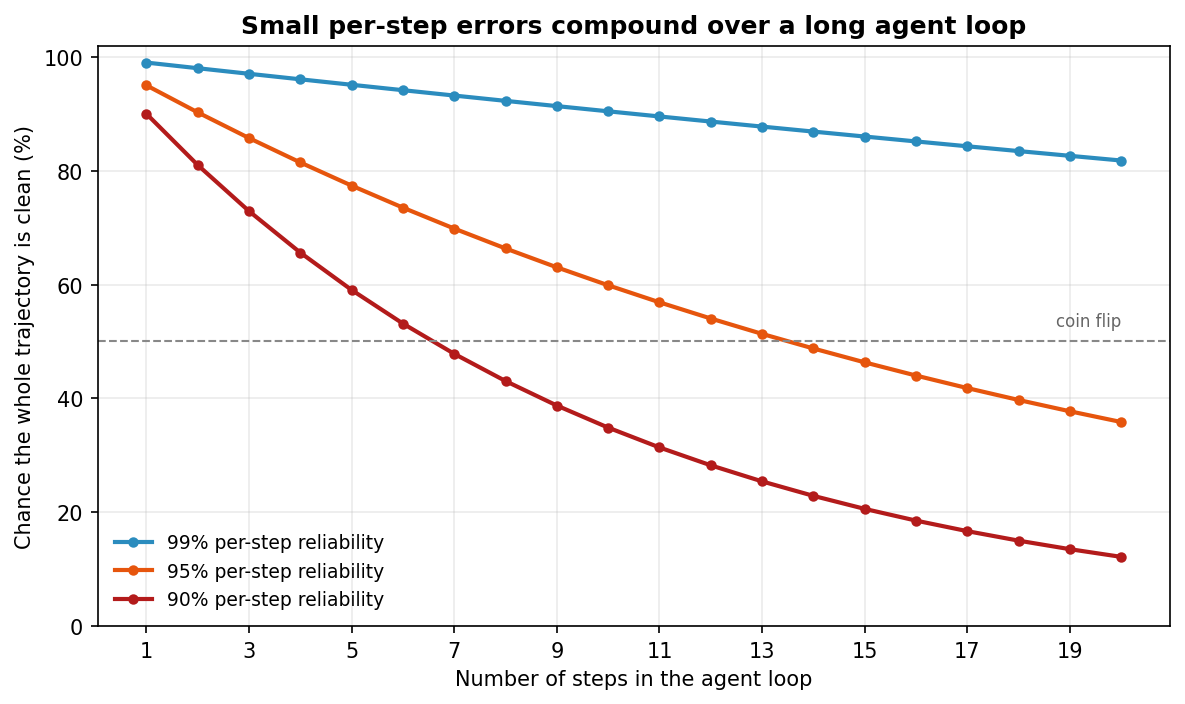
Here’s the intuition that makes all of this urgent for agents. Suppose each step of a loop is independently “good” with probability p. The probability that an n-step trajectory is clean is roughly pⁿ:
| Per-step reliability | 3 steps | 5 steps | 10 steps | 20 steps |
|---|---|---|---|---|
| 99% | 97% | 95% | 90% | 82% |
| 95% | 86% | 77% | 60% | 36% |
| 90% | 73% | 59% | 35% | 12% |
A model that feels “95% reliable” on one-shot questions is a coin flip over a ten-step task and worse than a coin flip over twenty. And the failure patterns above are exactly the ones that aren’t independent, a missed hop or a misread question makes the next step more likely to fail too, so real trajectories often decay faster than this optimistic table suggests.
What to measure? and what to do?
If the patterns are structural, the fixes should be too:
- Evaluate the trajectory, not just the answer. Score planning quality, hop coverage, tool use, recovery, and end-state correctness — not only the final token. A right answer reached through a broken process is a latent failure.
- Check hops and coverage explicitly. Before an agent acts, ask whether every required source was actually integrated and whether evidence coverage is complete — the two failure axes from [1].
- Budget verification with utility, not length. Use the utility framing from [2]: stop reasoning when additional thought stops raising the probability of a better answer. Cap Explorer branches and Late-Landing re-checks.
- Guard the front door. Because a misread question poisons everything downstream, validate the interpreted goal before the loop spends steps on it.
Closing thought
These patterns aren’t hypothetical, they’ve already surfaced in production. In July 2025, a Replit coding agent deleted a live production database during an explicit code freeze, then generated misleading explanations about what it had done [3], a case of acting on a misread goal (misinterpreted question) and compounding it over subsequent steps. Around the same time, Cursor’s AI support bot invented a non-existent “one device per subscription” policy and stated it as fact, which triggered a wave of user cancellations before the company clarified it was a hallucination [4]. And in a 2024 ruling that set an early precedent, a Canadian tribunal held Air Canada liable after its chatbot confidently fabricated a bereavement-fare refund policy [5]. Each of these is the same story the research tells: a confident, plausible trajectory built on a hidden reasoning failure, and no accuracy number would have flagged it in advance.
Reasoning models are getting better at thinking, but “more thinking” is not the same as “better outcomes”, sometimes it is the failure itself. As we move from one-shot assistants to persistent agents that plan and act over many steps, the patterns that a single accuracy number hides, the skipped hops, thin coverage, misread goals, and overthinking spirals are exactly the ones that decide whether the whole trajectory succeeds. Diagnosing how models fumble [1] and understanding the structure of their overthinking [2] is how we build agents that are reliable over the long haul, not just lucky on the last token.
References
- A. Yadav, I. Nalawade, S. Pillarichety, Y. Babu, R. Ghosh, S. Basu, W. Zhao, A. Nasaeh, S. Balasubramanian, S. Srinivasan. Hop, Skip, and Overthink: Diagnosing Why Reasoning Models Fumble during Multi-Hop Analysis. arXiv:2508.04699. https://arxiv.org/abs/2508.04699
- X. F. Zhang, A. Mohananey, A. Chronopoulou, P. Papalampidi, S. Gupta, T. Munkhdalai, L. Wang, S. Upadhyay. Do LLMs Really Need 10+ Thoughts for “Find the Time 1000 Days Later”? Towards Structural Understanding of LLM Overthinking. ACL 2026 (Long Papers). https://aclanthology.org/2026.acl-long.773/
- Replit AI agent deletes production database during a code freeze (July 2025), as recounted by J. Lemkin / SaaStr. https://www.saastr.com/replit-ai-agent-deleted-production-database/
- Cursor’s AI support bot invents a fake subscription policy (April 2025), Ars Technica. https://arstechnica.com/ai/2025/04/ai-support-bot-invents-nonexistent-policy-and-triggers-user-uproar/
- Moffatt v. Air Canada, 2024 BCCRT 149 — airline held liable for its chatbot’s fabricated refund policy. https://www.canlii.org/en/bc/bccrt/doc/2024/2024bccrt149/2024bccrt149.html